The Milan Cathedral: Six Centuries of Stone, Faith, and Genius
The Milan Cathedral: Six Centuries of Stone, Faith, and Genius
Duomo di Milano — a marble epic of endurance and devotion
The Eternal Work of Faith
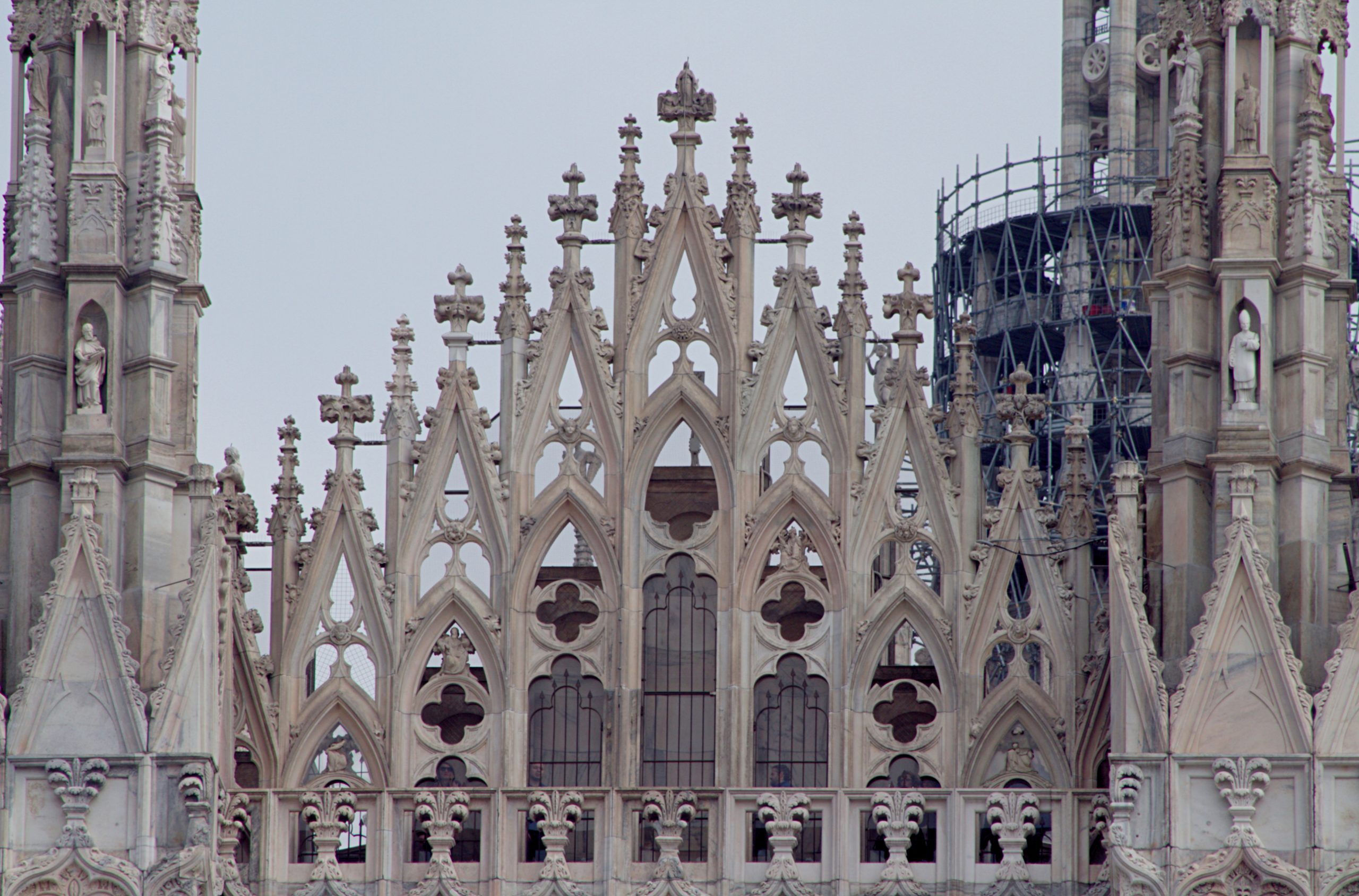
The Milan Cathedral (Duomo di Milano) began in 1386 and reached formal completion in 1965 — nearly six centuries. It stands among the largest Gothic cathedrals on earth, a living monument to endurance and devotion. Generations of masons, sculptors, and craftsmen labored so that stone could touch heaven. This is the heart of our focus: Milan Cathedral Duomo di Milano history.
Marble came from the Candoglia quarries, ferried on Navigli barges marked A.U.F. — Ad Usum Fabricae, “for the work of the Cathedral,” exempting the stone from tolls. The rose-tinted marble gives the façade its living glow, shifting with the Lombard light. Craft met logistics — a Renaissance supply chain powering a medieval dream.
Through wars, plagues, and changing rulers, work continued. Architects and masters — from Simone da Orsenigo to Carlo Amati — added visions without betraying the whole. In the 19th century, Napoleon pushed the façade toward completion in time for his Milan coronation. The interior remains a forest of stone — colossal piers, stained glass, and a nave that swallows noise into silence.
As the cathedral rose, Milan thrived below. Many European cities already had running water systems and fountains; Milan’s Navigli canals moved marble, grain, and people. Faith above, engineering below — that fusion of beauty and utility is the Milanese way.
By the 20th century the last spires were set, crowning the cathedral with the gilded Madonnina. With 135 spires and thousands of statues, the Duomo became more than a church — it is Milan’s identity in stone: patient, devoted, and unbreakably Italian.
Christopher Columbus: The Man Who Rewired the World
Christopher Columbus: The Man Who Rewired the World
A heritage layout with embedded images and full source links
The Daring Voyage Across the Atlantic
Christopher Columbus is often remembered as one of the bravest men in history, renowned for his daring voyage across the Atlantic in 1492. His historic journey, undertaken in an era when many still believed the world was flat, was nothing short of remarkable. Sailing in small wooden ships, with only the stars to guide him, Columbus and his crew faced the vast unknown. The thought of venturing beyond the familiar waters of Europe, into a seemingly endless ocean that could lead to the edge of the Earth, would have terrified most. Yet Columbus was driven by an unwavering belief in his mission—to find a westward route to Asia. As his ships, the Niña, Pinta, and Santa María, ventured farther from shore, the men faced rough seas, dwindling supplies, and the constant fear of what lay beyond the horizon. In the face of all this, Columbus remained steadfast, and his boldness forever changed the course of history.
Born in 1451 in the bustling port city of Genoa, Italy, Columbus was surrounded by the sea from a young age. Though Genoa was part of the broader Italian peninsula, Columbus was proud of his Roman heritage, claiming descent from the bloodline of the ancient Romans who had built the empire that spanned continents. This sense of lineage, rooted in the grandeur of Rome, shaped Columbus’s view of exploration and conquest. His family, though not wealthy, supported his early education, and by his teenage years, Columbus had already embarked on several maritime journeys, honing his navigational skills. At a time when exploration was rapidly expanding the known world, Columbus dreamt of new horizons. He became convinced that the shortest route to Asia’s riches lay not by traveling east, as many believed, but by sailing west across the Atlantic. This radical idea, fueled by his studies of geography and ancient maps, set him apart from other navigators of his time. Despite years of rejection from European courts, Columbus’s persistence eventually caught the attention of Queen Isabella and King Ferdinand of Spain, who agreed to sponsor his daring venture.
In August 1492, Columbus set sail from Palos de la Frontera, Spain, with three ships and a crew of about 90 men. His destination was Asia, but his journey would lead him to an entirely new world. The voyage was perilous, with storms and the threat of mutiny as his crew grew increasingly anxious about the long, unknown stretch of water before them. Yet Columbus held firm, promising them that land was near. Finally, after more than two months at sea, on October 12, 1492, they sighted land—the islands of the Caribbean, though Columbus believed they had reached the outskirts of Asia. The sight of palm trees and sandy shores must have been a relief, but the true magnitude of his discovery would not be understood for years to come.
Columbus’s voyages marked the beginning of an era of European exploration and expansion in the Americas. Over the course of four expeditions, he explored various Caribbean islands, parts of Central America, and the northern coast of South America. Although he never realized he had discovered a “New World,” Columbus’s voyages opened up the Americas to European powers, forever altering the history and destiny of civilization. His return to Spain after the first voyage was celebrated as a triumph, though his later expeditions were fraught with difficulties, including shipwrecks, rebellion among his men, and eventual political fallout.
Columbus’s legacy is that of a visionary and a pioneer who defied the limits of his time. His voyages paved the way for the greatest era of discovery and exchange in human history. While the world he opened was later marked by conquest and hardship, his courage and conviction remain unmatched. Few men in history have ever displayed such audacity—to challenge centuries of fear, sail beyond the known map, and in doing so, change the course of civilization forever.
Columbus remains one of the most influential figures in human history. His voyages across the Atlantic proved that the world was far larger than anyone had imagined, dispelling ancient myths and sparking an age of exploration. Crossing the ocean when many feared it was impossible, Columbus showed the power of human curiosity and ambition, forever reshaping the world’s understanding of geography and possibility. His courage in the face of overwhelming odds, both at sea and in the courts of Europe, stands as a testament to the spirit of exploration—driven by Roman blood, divine vision, and unbreakable will.
Columbus didn’t just sail west — he rewired the human imagination. He took a world locked in superstition and fear and proved that courage, not consensus, defines reality.
While today’s academics rewrite his story from comfortable desks, the truth remains unshakable: without that one man’s audacity in 1492, the modern world — the hemispheres united, the exchange of ideas, goods, and progress — would have never existed.
He was not a villain of hindsight but a visionary of destiny.
A man of faith, iron, and Roman blood — who looked at an ocean everyone feared and said: